
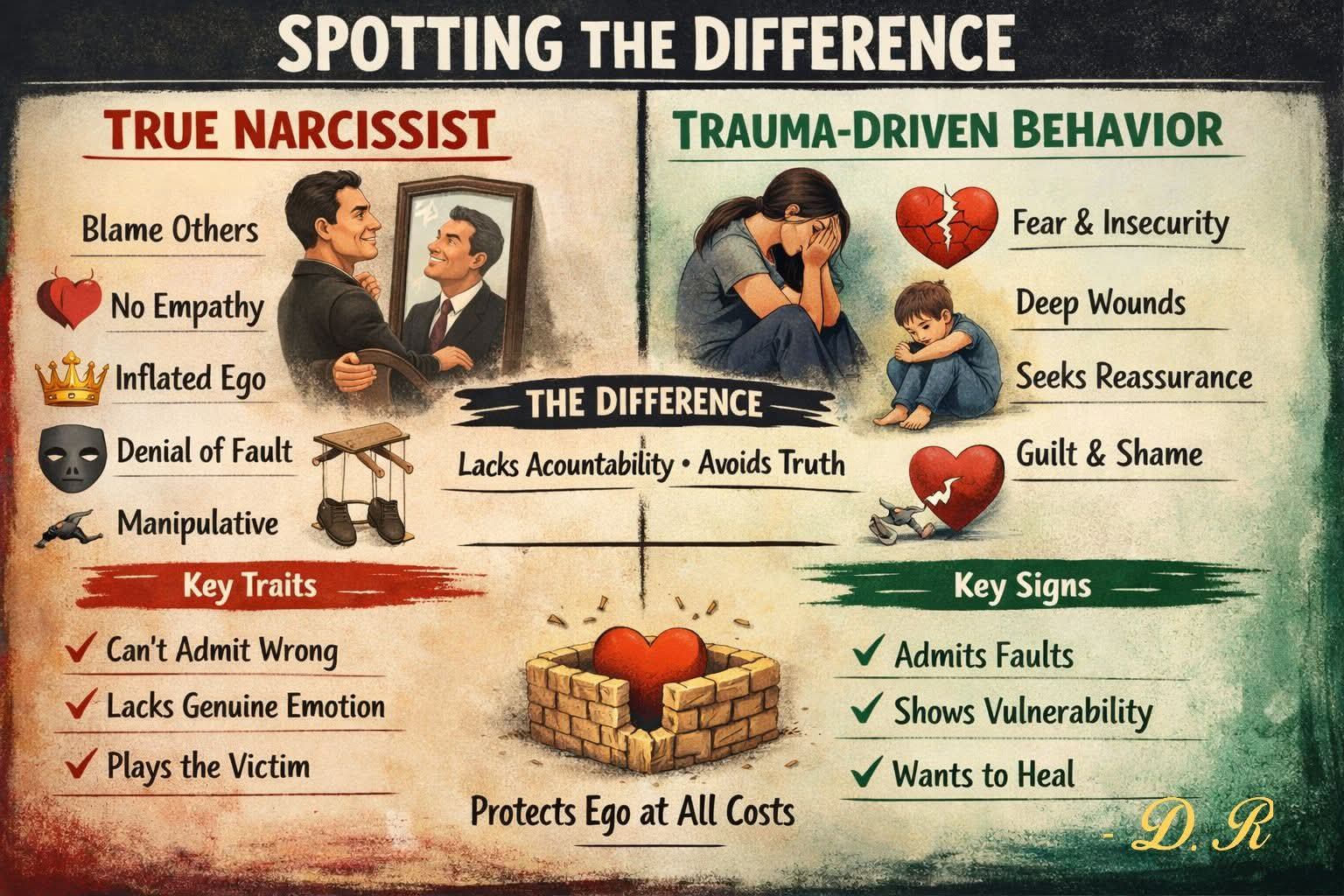
A great deal is said about narcissism, yet very little is truly understood.
The word is used quickly, often far too quickly, as though every controlling, dominant, selfish, or difficult behavior automatically qualifies as narcissism. That is inaccurate. And that is precisely where the confusion begins.
Because yes:
every human being has narcissistic traits.
Every human being has an ego.
Every human being wants to be seen, acknowledged, influential, sometimes right, sometimes protective of what feels vulnerable.
That is not automatically pathology.
That is humanity.
So the real question is not whether someone has narcissistic traits.
The real question is:
what happens when a person’s self-image is threatened?
What happens when confrontation arises?
When responsibility is required?
When pain becomes visible?
When control disappears?
Within Esoteric Mastery, we do not look only at behavior, but at the underlying structure.
At the psychic architecture of the subconscious, where survival patterns, defense mechanisms, attachment wounds, and shadow structures are stored , and at the layers of consciousness where truth, order, and responsibility can emerge.
First, let this be absolutely clear:
A person can behave in ways that appear narcissistic while actually operating from trauma.
That behavior may be controlling, dominant, jealous, possessive, defensive, demanding, easily wounded, manipulative under stress, or hungry for validation.
That can be deeply painful for others.
It should never be minimized.
But this is still not the same as a deeply narcissistic structure.
Why not?
Because in trauma-driven narcissistic traits, the core is usually not grandiosity, but fear.
Not genuine inner superiority,
but inner collapse being covered over.
Not cold exploitation as a foundation,
but survival.
That distinction changes everything.
A traumatized person with narcissistic traits is often not trying to dominate, but trying to prevent old pain from being activated again.
Control then arises not from power, but from fear.
Dominance becomes armor.
Possessiveness becomes abandonment fear.
Anger becomes a body with no capacity to hold vulnerability.
Not every ego is narcissism.
Sometimes it is an emergency structure built over a foundation of shame and insecurity.
So how do you recognize the difference?
Not through perfect behavior,
but through the relationship to truth.
Can someone, once the defenses settle, look back and say:
“This was my part”?
Can they genuinely feel the harm they caused?
Can shame be tolerated without immediately escaping into attack or denial?
Is there capacity to learn?
That is where the distinction lies.
A person with trauma-driven narcissistic traits may display difficult behavior, but there is often still a doorway toward insight.
Sometimes small.
Sometimes hidden.
But the doorway exists.
And when real inner work is taking place, you begin to see movement:
Reactions begin to change under pressure
Awareness arises before behavior
Responsibility is taken without detours
Feeling begins replacing control
This is not theory.
It becomes visible in behavior.
With a truly narcissistic structure, it is different.
There, the ego is not merely protection.
It becomes the organizing principle of the entire inner reality.
Reality itself is shaped in such a way that the person’s own contribution remains out of sight, while the other becomes the carrier of blame.
And this does not always appear loud or arrogant.
Narcissism can also present itself as charming, intelligent, helpful, or even spiritual.
The core question always remains:
What happens during confrontation?
If the pattern is structural:
The other person is always the problem
Criticism is experienced as attack
Apologies become strategic rather than sincere
Empathy becomes selective
Responsibility is avoided
Then we are dealing with a different order of functioning.
Here lies an important truth:
Many people who claim they are “working on themselves” are actually working on their self-image.
Real change is not measured through words.
It becomes visible through behavior under pressure.
When genuine inner work is happening:
a person can stop
a person can return
a person can acknowledge without adding “but”
a person can tolerate discomfort
the environment becomes safer, not more confusing
Bodywork plays a crucial role in this.
The body lies less than the story.
A traumatized system often lives in tension:
fight,
flight,
freeze,
or adaptation.
When development occurs, space begins to emerge between trigger and reaction.
Regulation appears.
Choice appears.
That is where the real shift happens.
Within a rigid narcissistic structure, you see far less of this movement.
Less genuine curiosity.
Less grief.
Less willingness to truly allow shame.
The other person continues serving a function:
mirror,
validator,
opponent,
or scapegoat.
As long as the other person adapts, balance appears to exist.
The moment boundaries emerge,
the underlying structure reveals itself.
One major misunderstanding is the belief that people with narcissistic structures feel nothing.
That is not true.
They do feel.
But those feelings cannot freely exist without threatening the self-image.
And so:
shame becomes attack
fear becomes control
sadness becomes distance
The emotional world is not absent.
It is sealed off.
And here lies the deepest teaching:
Narcissism is not a problem of ego size,
but of closure toward truth.
And healing is not the destruction of the ego,
but making the ego permeable.
A healthy human being:
can carry strength without dominating
can be visible without depending on validation
can be wounded without distorting reality
can take responsibility without collapsing internally
So when the question arises:
“Am I narcissistic?”
The answer does not lie only in behavior,
but in relationship to truth.
Is there willingness to look?
Is there capacity to remain with discomfort?
Is real change becoming visible through action?
That is where the distinction lies.
And precisely there,
true power begins.
Lumina Vitae
Don Rodolfo